Business Strategies for Surviving and Thriving in Turbulent Times
Adapting on the Fly

In today's fast-paced world, change is the only constant. A staggering 82% of board members and CEOs in EY’s Global Board Risk Survey said market disruptions have become more frequent and impactful. From economic downturns and natural disasters to global pandemics and technological revolutions, the modern business environment is a minefield of uncertainties and challenges.
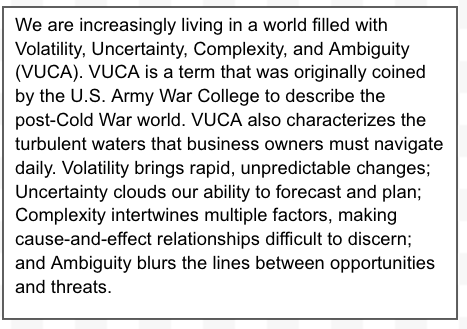 At some point in time your business will face a crisis caused by external sources out of your control. During this time of upheaval, adaptability isn't just a desirable trait but a crucial survival skill. The ability to pivot quickly, reassess strategies, and seize unexpected opportunities can mean the difference between a business that thrives and one that barely survives or worse ceases to exist.
Adaptability in business is both an art and a science and is best leveraged when built into an organization's DNA. How can you respond effectively when disruptions inevitably occur? How can you turn turbulent times into opportunities for growth and innovation? In a world where change is the only certainty, your greatest asset is your ability to adapt on the fly. Let's discover how you can not only weather the storms of business disruption but harness their power to propel your organization to new heights.
The Importance of Adaptability
What exactly does adaptability mean in a business context? At its core, business adaptability is the capacity of an organization to efficiently alter its strategies, processes, and structures in response to changing circumstances. It's the ability to not just weather storms but to harness their energy and emerge stronger. A business that is adaptable and, therefore, best able to manage through business interruptions and disruptions needs to exhibit these key elements:
- Flexibility – they must be able to pivot strategy and tactics.
- Agility – in their decision-making and execution.
- Resiliency – bounce back when faced with setbacks.
- Openness - to new ideas and innovations.
- Strength – to challenge the status quo.
An adaptable business is one that can quickly pivot its operations, reallocate resources, and modify its offerings to meet new market demands or overcome unexpected challenges. Adopting a culture of adaptability within an organization can have numerous and far-reaching benefits, including:
- Increased Resilience: Adaptable businesses are better equipped to withstand shocks and disruptions. They bounce back faster from setbacks and are less likely to be caught off guard by sudden changes.
- Enhanced Problem-Solving: Companies that prioritize adaptability often develop a culture of creative thinking and innovation. This leads to more effective problem-solving across all levels of the organization.
- Improved Customer Satisfaction: Adaptable businesses can quickly adjust their products or services to meet changing customer needs, leading to higher satisfaction and loyalty.
- Sustainable Competitive Advantage: In rapidly evolving markets, the ability to adapt quickly can be a significant differentiator, allowing businesses to outmaneuver less agile competitors.
- Employee Engagement and Retention: Employees in adaptable organizations often feel more empowered and engaged, as they're encouraged to contribute ideas and take initiative in responding to challenges.
- Better Resource Utilization: Adaptable companies are often more efficient, as they can quickly reallocate resources to where they're most needed, reducing waste and improving overall productivity.
A recent example of a business that has been faced with a market and technological disruption and has adapted and is thriving is Netflix. Founded in 1997 as a DVD-by-mail rental service, Netflix recognized the potential of streaming technology early on. In 2007, they launched their streaming service, fundamentally changing their business model. As streaming gained popularity, Netflix adapted again, investing heavily in original content production to differentiate itself in an increasingly crowded market.
Netflix anticipated market trends and technological shifts, had the strength to cannibalize its own successful DVD rental business, and was open to new ideas that led to continuous innovation in content delivery and production. Netflix demonstrates that adaptability isn't just about surviving disruptions — it's about thriving despite them. Companies that can quickly and effectively adapt to change are not only more likely to survive in turbulent times but are also better positioned to seize new opportunities and drive innovation in their industries.
Strategies for Building Adaptability
While the importance of adaptability is clear, cultivating this trait within an organization is no easy task. It requires a deliberate and sustained effort to reshape company culture, processes, and mindsets. Key strategies that business owners and leaders can employ to build adaptability into the very fabric of their organizations include:
- Foster a Culture of Continuous Learning: Encourage employees at all levels to acquire new skills, stay informed about industry trends, and embrace a growth mindset.
- Embrace Agile “Like” Methodologies: Originally developed for software development, Agile principles can be applied broadly to enhance organizational adaptability.
- Develop a Diverse and Inclusive Workforce: Diversity and inclusion in this context refers to those with backgrounds, experiences, and perspectives that can significantly enhance an organization's ability to adapt to new challenges. If everyone has the same perspective, then seeing what may be out of view becomes nearly impossible.
- Establish Cross-Functional Teams: Breaking down silos and encouraging collaboration across departments can lead to more innovative solutions and faster adaptation to change.
- Perform Regular Scenario Planning: Preparing for multiple possible futures can help organizations respond more quickly when changes occur.
- Cultivate a Fail-Fast, Learn-Fast Mentality: Creating an environment where calculated risks are encouraged and failure is seen as a learning opportunity can drive innovation and adaptability.
- Prioritize Customer-Centricity: Staying closely attuned to changing customer needs can help organizations adapt proactively rather than reactively.
- Build a Flexible Organizational Structure: A less hierarchical, more networked organizational structure can facilitate faster decision-making and adaptation.
- Develop Strategic Partnerships: Building a network of strategic partnerships can provide access to complementary skills and resources, enhancing overall adaptability.
- Invest in Technology and Digital Transformation: Leveraging technology can significantly enhance an organization's ability to adapt quickly to changing circumstances.
By implementing even a few of these strategies, organizations can build the muscles of adaptability, becoming more resilient, innovative, and ready to thrive in an ever-changing business landscape.
Responding to Disruptions Effectively
Business interruptions and disruptions are not a matter of if but when. The ability to respond effectively to them can make the difference between a business that thrives and one that merely survives — or worse, fails. Below are strategic approaches that businesses can adopt to respond to disruptions effectively, all of which are underpinned by the critical quality of adaptability.
- Establish a Rapid Response Team: Create a cross-functional team dedicated to managing disruptions, ensure this team has the authority to make quick decisions and include members from various departments to provide diverse perspectives.
- Develop and Regularly Update Contingency Plans: Create plans for various potential disruptions (e.g., supply chain issues, economic downturns, natural disasters), regularly review and update these plans to ensure they remain relevant and conduct simulations or drills to test the effectiveness of these plans.
- Prioritize Clear and Frequent Communication: Establish multiple channels for communication (e.g., video conferencing, instant messaging, email), provide regular updates to all stakeholders, including employees, customers, and partners and ensure messaging is consistent, clear, and transparent.
- Focus on Customer Needs: Actively seek customer feedback during disruptions, be prepared to quickly adjust products or services to meet changing customer needs and proactively communicate with customers about any changes or issues.
- Rapid Resource Allocation: Develop systems for quickly reallocating resources (both human and financial) as needed, consider cross-training employees to increase workforce flexibility, and maintain sufficient financial reserves or lines of credit for unexpected needs.
- Foster Innovation and Creative Problem-Solving from All Levels: Encourage employees at all levels to propose solutions to disruption-related challenges, create safe spaces for experimentation and calculated risk-taking, and reward innovative thinking, even if the ideas aren't ultimately implemented.
- Strengthen and Diversify Supply Chains: Develop relationships with multiple suppliers in different geographic regions (e.g., challenger/champions supplier structure), regularly assess and stress-test your supply chain for vulnerabilities, and consider vertical integration for critical components when feasible.
- Prioritize Employee Well-being: In order to not just survive but thrive you will need to retain legacy knowledge by providing resources to support employee mental and physical health during disruptive periods, offer flexible work arrangements when possible and ensure clear communication about any changes to roles or expectations.
- Train Like Your Life Depends On It: Learn and improve continuously by conducting thorough post-disruption reviews to identify areas for improvement, documenting lessons learned and incorporating them into future planning, and cultivating a culture where learning from challenges is valued and expected.
By implementing these strategies, businesses can build their capacity to respond effectively to disruptions. Remember, the goal isn't just to have a plan for every possible scenario, that's impossible in our rapidly changing world. Instead, the aim is to build an organization that's inherently adaptable and able to respond quickly and effectively to whatever challenges arise. This adaptability is what will allow your business not just to weather storms, but to find opportunities for growth and innovation even in the most turbulent times.
Thriving in the Age of Disruption
In this era of unprecedented change and uncertainty, the ability to adapt has become more than just a desirable trait, it is an essential survival skill for businesses of all sizes and across all industries. Adaptability is the key to not only weathering the storms of disruption but also discovering new opportunities for growth and innovation amidst the chaos.
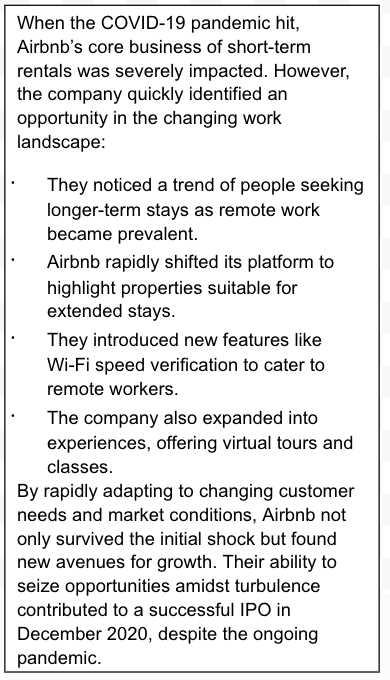 Adaptability is the quality that allows businesses to pivot quickly, reassess their strategies, and emerge stronger from periods of turbulence. It is not a trait that develops overnight. It requires a deliberate and sustained effort to reshape organizational culture, processes, and mindsets.
The businesses that will thrive in the coming years will be those that view disruption not as a threat but as a catalyst for positive change. They will be the ones that have built adaptability into their DNA, creating flexible structures and processes that allow them to pivot quickly in response to changing circumstances. These organizations will be characterized by their resilience, their innovative problem-solving capabilities, and their ability to turn challenges into opportunities for growth.
Remember, adaptability is not about predicting the future or having a plan for every possible scenario. It's about building an organization that can respond effectively to whatever challenges arise, one that can learn and evolve continuously in the face of change. It's about creating a culture where flexibility, innovation, and resilience are valued and nurtured.
As you navigate the turbulent waters of today's business environment, let adaptability be your north star. Embrace change, cultivate resilience, and remain open to the opportunities that lie hidden within every challenge. By doing so, you'll position your business not just to survive in turbulent times, but to thrive and lead in the age of disruption.

Ken Fick is a CPA, and MBA with over 25 years of finance experience providing leading-edge solutions designed to improve forecasting, budgeting, planning, and decision-making to companies from $3 million to over $50 billion in revenue. He is a freelance writer that focuses on producing engaging content on all things business, accounting, finance and investment related. You can view a sampling of his published work at FPAexperts.com.