From Business Owner to Retiree: Navigating the Tax Landscape
Minimize Taxes and Achieve the Retirement You've Envisioned

According to the US Small Business Administration’s SCORE program, around 5 million businesses that hold over $10 trillion in assets will change hands of ownership over the next decade or so, but over 60% of small business owners don't have a documented and communicated succession plan in place. These startling statistics underscore a critical oversight in the entrepreneurial journey — one that could cost business owners dearly when it's time to hang up their hats.
As business owners approach the golden years of retirement, selling their business is a pivotal moment, not just in their career but in their financial future. However, without proper tax planning, they may find themselves handing over a sizable portion of their hard-earned profits to the IRS.
Tax planning is the unsung hero in the story of a successful business exit. It is the difference between watching your life's work translate into a comfortable retirement and seeing it whittled away by an unexpected tax burden. Unlike larger corporations with deep pockets and a wide professional advisor network, small business owners often lack the extensive resources and expert teams to navigate the complex tax implications of a business sale.
This article aims to demystify the tax landscape for entrepreneurs on the brink of retirement by exploring effective strategies to minimize tax liabilities and maximize profits from the sale of a small business. When it is time to sell your business and retire, it is not just the price you sell it for but what you are able to retain after taxes.
Understanding Tax Implications of A Business Sale
When selling a business, it is crucial to understand the various tax implications that can arise.
Capital Gains Tax
The sale of a business is typically subject to capital gains tax. This tax is levied on the profit made from the sale, which is the difference between the sale price and the original purchase price (adjusted for any improvements or depreciation). There are two types of capital gains:
- Short-term capital gains: These apply if the business is held for one year or less and are taxed at ordinary income tax rates. Short-term capital gains will, most likely, not impact the sale of most small businesses as they are held much longer than one year.
- Long-term capital gains: These apply if the business was held for more than one year and are taxed at reduced rates, which can be significantly lower than ordinary income tax rates. As of 2024, long-term capital gains tax rates range from 0% to 20%, depending on your income level.
When selling a business, how the purchase price is allocated can have a substantial impact on the taxes that a seller pays and can frequently become another area of negotiation after the price, terms, and conditions of the sale have been agreed upon. The IRS categorizes assets into different classes, each with different tax treatments. These typically include:
- Cash and cash equivalents
- Inventory
- Accounts receivable
- Equipment and machinery
- Real estate
- Intangible assets (goodwill, patents, trademarks, etc.)
As a seller, you want to try to allocate as much of the purchase price to assets that will be taxed as capital gains rather than ordinary income. For example, a seller should negotiate as much of the purchase price allocation to goodwill as possible because the IRS taxes that at capital gains rates while minimizing the allocation to inventory and accounts receivable as they are usually taxed as ordinary income.
A seller should be cautious with any purchase price allocation to depreciable assets because selling depreciable assets for more than their depreciated value can trigger depreciation recapture, which is taxed as ordinary income.
If the sale includes any type of real estate that has been held for more than one year, that is also taxed at the long-term capital gains rate. While any income related to a covenant not to compete is typically taxed at the ordinary tax rate and can be a leverage point of negotiation in the sale
If possible, negotiate the sale as a stock sale instead of an asset sale. Stock sales are typically treated entirely as capital gains, but buyers usually prefer asset sales for the step-up in basis.
Remember, while the above strategies may help minimize ordinary income tax, it's crucial that the allocation accurately reflects the true value of the assets. Any allocation must be reasonable and justifiable if scrutinized by tax authorities.
Section 1031 Exchanges
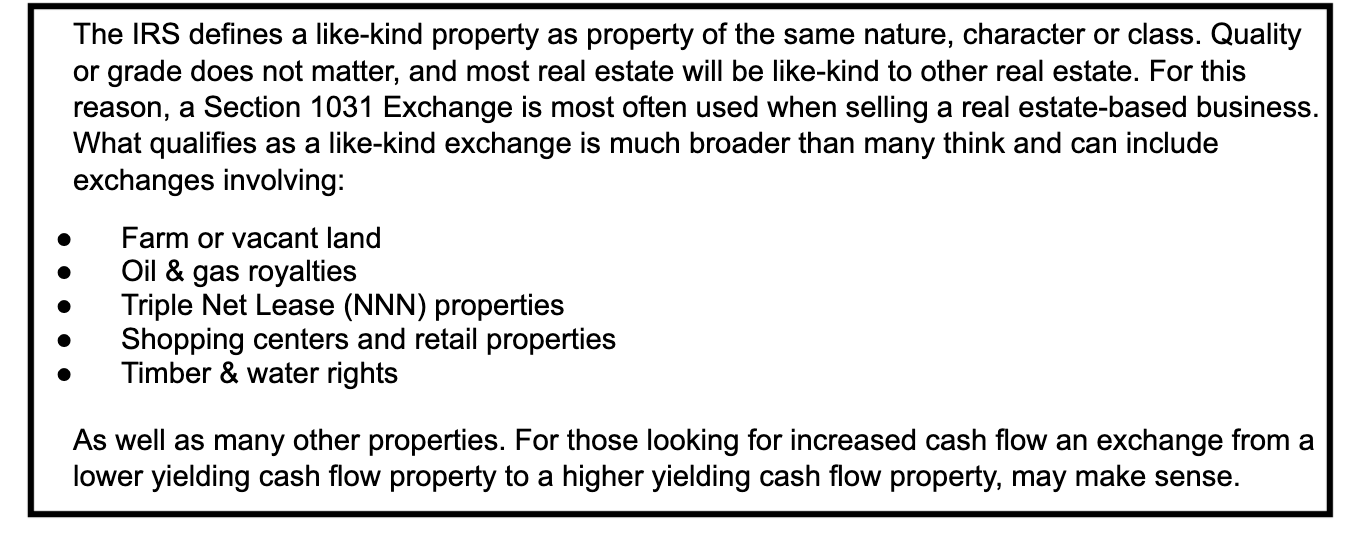 It can be tricky, but if you own a real estate-heavy business and don’t immediately need the capital to fund your retirement, then you may want to consider a Section 1031 exchange. Also known as a like-kind exchange, this allows business owners to defer capital gains taxes by reinvesting the proceeds from the sale into a similar property. This can be particularly beneficial for those looking to continue investing in their industry without incurring immediate tax liabilities. The two key benefits of a Section 1031 Exchange are:
- Tax deferral: By reinvesting in like-kind properties, you can defer paying capital gains taxes until you eventually sell the new property.
- Increased purchasing power: Deferring taxes allows you to reinvest the full proceeds from the sale, potentially enabling you to acquire more valuable properties.
Rollover Equity
If you are interested in a second bite at the apple and have confidence in the buyer, some business owners may choose to sell their business but retain an equity stake in the acquiring company. This can offer several advantages:
- Continued involvement: Retaining equity allows you to remain involved in the business and potentially benefit from its future growth.
- Tax deferral: By rolling over your equity, you can defer capital gains taxes until you eventually sell your stake in the acquiring company.
ESOPs (Employee Stock Ownership Plans)
This is a significantly underutilized, tax-efficient strategy that has many intangible and long-term benefits for the business’s employees and the community at large. Selling a business to your employees through an ESOP can have unique tax implications and benefits:
- Tax advantages: Contributions to an ESOP are tax-deductible, and selling to an ESOP can allow you to defer capital gains taxes if you reinvest the proceeds in qualified replacement property. Qualified replacement property consists of domestic stocks, bonds, and corporate floating rate notes (subject to certain rules), which are common assets held in a retirement account. By holding the replacement property until death, the investor's heirs can benefit from a step-up in basis, eliminating capital gains taxes on both the original investment and any appreciation.
- Employee benefits: ESOPs can provide employees with a sense of ownership and potentially improve company performance and employee retention. There are also huge ongoing operating benefits. For example, a 100% ESOP-owned S corporation enjoys the unique benefit of not paying federal or state income taxes, effectively operating as a tax-exempt entity while conducting for-profit business. This tax advantage can provide a significant competitive edge.
In addition to the above, consideration should be given to estate taxes. Proceeds from the sale of a business can be significant, and estate taxes can prove to be as much of an issue as income and capital gains taxes. As of 2024, the current estate tax threshold is $13.61 million. This means that if the estate is valued for more than this amount, it may be subject to federal estate taxes.
Tax-Efficient Retirement Strategies
It’s not just for how much and how you sell your business, but what you do before and after that matters as well. If you have been a diligent saver and taken advantage of the plethora of small business retirement accounts such as a traditional 401K, SEP, or SIMPLE IRA and profit-sharing plans, you may be facing Required Minimum Distributions (RMDs) that could increase your taxable income, potentially pushing you into a higher tax bracket. Here are some effective strategies to lower your RMDs:
- Start converting your tax-deferred IRA to a Roth IRA: Converting only the amount that would keep you below the next tax tier on an annual basis offers the benefit of 100% tax-free qualified withdrawals in retirement and no RMDs.
- Delay Retirement: As long as you remain employed, you can postpone taking RMDs from your company's retirement plan. Unfortunately, that exception doesn’t apply to retirement accounts held with previous employers or IRAs either.
- Charitable Contributions: You can make tax-free charitable donations of up to $100,000 annually directly from your IRA. These donations will count towards your RMD, eliminating the risk of a 50% penalty for failing to take withdrawals.
- Tax-Deferred Annuities: A Qualified Longevity Annuity Contract (QLAC) is a type of deferred annuity contract that can be purchased with retirement funds. For 2024, an individual can only contribute up to $200,000 per year ($400,000 for couples) as a lifetime limit. Payments are required beginning at age 85 (but can start sooner) and any money you put into the annuity from a retirement account is not factored into your RMD calculations.
- Municipal bonds: Municipal bond interest is generally exempt from Federal income tax and sometimes state and local taxes as well. This means that your overall taxable income will be lower, potentially reducing the amount of RMD you need to withdraw from your tax-deferred retirement accounts.
Seek Professional Advice
It’s best not to go it alone. Consulting with a tax advisor, financial planner, or attorney to develop a personalized tax minimization strategy is the best course of action. Qualified professionals know the importance of regularly reviewing and updating your tax plan to account for changes in tax laws, your financial situation, and your retirement goals.
Conclusion
The journey from business owner to retiree is fraught with challenges, particularly when it comes to navigating the complex tax landscape of a business sale. With a significant number of small business owners lacking a documented succession plan, the importance of tax planning cannot be overstated. Proper tax strategies can mean the difference between a comfortable retirement and an unexpected financial burden. By understanding and implementing effective tax planning techniques, business owners can ensure that their hard-earned profits are maximized, allowing their entrepreneurial legacy to support the retirement they have always envisioned.
DealStream, its authors and affiliates do not provide tax, legal or accounting advice. This material has been prepared for informational purposes only, and is not intended to provide, and should not be relied on for, tax, legal or accounting advice. You should consult your own tax, legal and accounting advisors before engaging in any transaction.

Ken Fick is a CPA, and MBA with over 25 years of finance experience providing leading-edge solutions designed to improve forecasting, budgeting, planning, and decision-making to companies from $3 million to over $50 billion in revenue. He is a freelance writer that focuses on producing engaging content on all things business, accounting, finance and investment related. You can view a sampling of his published work at FPAexperts.com.