How Do CEOs Spend Their Time?
Proven tips to stay on top of everything.

If you’re reading this piece, there’s a good chance you are either a small business owner already or about to become one with the purchase of a business. That means your life is either busy or about to be. As the CEO of your own small business, you’ll be responsible for everything from product development and manufacturing to sales, marketing, and raising the revenue to expand your enterprise.
Moreover, everyone in the organization will want a piece of you because, as chief executive officer, you are the central cog in a machine with diverse moving parts, and it’s your job to make sure the gears around you remain in proper alignment.
So how do CEOs stay on top of everything? Read on to learn how you can develop the proven time management skills that have helped successful CEOs and entrepreneurs structure their days.
A Day in the Life of the Average CEO
Surprisingly, the time management of CEOs is a topic that doesn’t receive a lot of attention. Most online discussion centers on a 2018 study conducted by the Harvard Business Review (HBR), which followed the lives of 27 CEOS (25 male, two female) for a full three-month quarter. The companies were large, with an average annual revenue of $13.1B.
Researchers affiliated with the study trained each CEO’s executive assistant to code their time in 15 minute increments, 24 hours a day.
Here are some of the study’s main takeaways:
- They work more hours. CEOs in the study averaged 9.7 hours weekday hours. They also worked on weekends 79% of the time (an average of 3.9 hours each day) and worked on vacations 70% of the time (2.4 hours each day). That adds up to an average work week of 62.5 hours.
- They only spend about half of their working hours at the office. CEOs spend as much time meeting external contingencies and traveling to work-related events as they do behind the desk at their remote or in-person offices.
- They maintain family ties and personal wellness goals during the hours spent not working. In the roughly six hours per day that CEOs in the study were not either working or sleeping, they devoted approximately half to family and the other half to the pursuit of hobbies, exercise, and passive relaxation activities like watching television.
- They interact with people all day long. Because every division in a company must answer to the CEO, the job is all about meetings. CEOs spend the most time (61%) in face-to-face meetings. The rest of the working day is spent taking phone calls and answering emails. CEOs of large companies must delegate; they spend anywhere from 32-67% of their time speaking to their direct reports.
- They spend a lot of that time deescalating potential crises. CEOs spend 36% of their time reacting to external and internal issues. Although the potential for situations to devolve into crises is there, the business leaders in the HBR study only spent 1% of their time, on average, in bonafide crisis mode.
- They operate according to an “explicit personal agenda” that lays out their priorities. The CEOs in the HBR study devoted, on average, 43% of their time to forwarding the goals of their core agenda and felt better about themselves when they were disciplined enough to work on it.
- They are still sweating the small stuff. The CEOs in the study still spent 11% of their work day executing routine tasks. Operating reviews take up the lion’s share of that time, with CEOs who were formerly COOs probably spending more time than they should on this endeavor.
Productivity and Lifestyle Tips To Bring Out Your Inner CEO
Be an Early Riser
Remember Ben Franklin’s adage? “Early to bed and early to rise makes a man healthy, wealthy, and wise.”
Well, it turns out he was right. People tend to focus better in the early morning hours, when there are fewer humans up and about to provide distractions. Overall, early risers have better mental health, tend to be more proactive and procrastinate less, eat healthier, and attain higher levels of fitness.
Some of what predisposes early birds to lead healthier lifestyles is opportunistic: night owls have fewer chances to work out between their peak hours of activity. But there also appears to be a correlation between waking early and maintaining a positive mood.
Find it impossible to get out of bed on cold, dark winter mornings? Mel Robbins, the motivational speaker and author of “The High Five: Take Control of Your Life with One Simple Habit,” recommends that you count “five-four-three-two-one-GO and move toward action” whenever you encounter resistance to a worthwhile goal.
In fact, this simple motivational tool is what gets Robbins out of bed in the mornings, herself.
Exploit the Mind-Body Connection
It’s probably no coincidence that CEOs in the HBR study spent 9% of their non-working hours, or about 45 minutes a day, exercising. Regular exercise helps to reduce depression, improve short term memory, increase energy levels, and improve the mind’s ability to regulate emotions.
Exercise lowers the risk of metabolic and cardiovascular disease, and it may help to stave off Alzheimer’s and related dementias as well. Thus, staying in shape is important not only for the sake of improved physical health; it is crucial for maintaining a positive attitude and keeping your powers of cognition strong.
Another way to help your brain to function optimally is making sure to eat a healthy diet. The MIND diet recommends that you consume mostly foods that are optimal for brain health—whole grains, vegetables, salad greens, olive oil, nuts, beans, poultry, fatty fish like salmon, and berries—while limiting red meat, animal fat, and processed foods.
Increase Your Emotional Intelligence
As the results of the HBR study show, CEOs spend most of their work day interacting with people face-to-face. This much engagement requires high levels of emotional intelligence (EQ).
According to Mark Manson, author of “The Subtle Art of Not Giving a F*ck,” EQ has five main components: self-awareness, self-regulation, motivation, empathy, and values. It is possible to work on strengthening each of these components.
Journaling, for instance, is one way to improve self-awareness. Learning to listen and ask leading questions can improve your powers of empathy. You can improve self-regulation, as I mention above, just by maintaining a regular exercise routine.
According to a study published in the National Library of Medicine, mindfulness meditation can also increase EQ, perhaps because it asks practitioners to look at events with a child’s immediacy and curiosity rather than imposing our preconceptions.
Master the Four Quadrants of Time Management
I first learned about this concept reading Stephen Covey’s classic, “7 Habits of Highly Effective People.” However, you may have come across the same idea labeled as the Eisenhower Matrix.
Either way, the principle remains the same. Our time is typically divided among the four quadrants featured below:
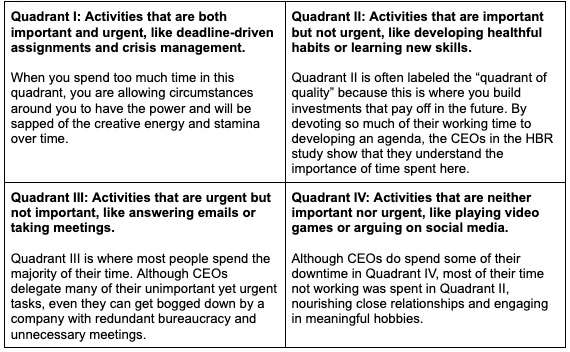
Successful CEOs spend considerable time in Quadrant II, developing the plans and skills it takes to get ahead and investing in family commitments and long-term self-improvement goals. They also minimize the time drain of Quadrant III by delegating tasks and limiting unnecessary meetings.
Learn How To Set an Agenda
My favorite productivity book of all time is David Allen’s “Getting Things Done: The Art of Stress-Free Productivity.” GTD, as his system is called, uses the following five steps to boost productivity in all areas of your life:
- Write down every individual thing you want to accomplish, from scheduling a hair appointment to developing a new product line.
- Decide whether the task is actionable. If it is, break it down into smaller actions. If the task would take less than two minutes to accomplish, do it immediately.
- Organize your tasks. Allen suggests writing them down in a calendar so that you know when to accomplish them.
- Review your organized list regularly, deciding which tasks will be modified, shelved for now, or trashed.
- Use your trusted system to get things done!
This method can be used to develop a business plan or set an agenda for the next phase of business operations, making it a great tool for entrepreneurs and CEOs of all stripes.
The Bottom Line
CEOs are dedicated to their work and put in long hours to make sure that the company they represent runs smoothly. They are both proactive and reactive, with high levels of emotional intelligence and the ability to set a clear agenda.
Although some of these skills may come naturally, all can be honed through practice and experience. Why not test your skills today by removing just one nagging task from your do-to list? It only takes one step to build a lifetime of solid business leadership practices.

Valerie is a freelance writer who specializes in real estate, finance, and business formation. When not writing, she can be found renovating her 200-year-old rental property on the coast of Maine.