Price Like a Pro: FP&A Hacks for Maximum Profitability
An Interview with Industry Leader, Paul Barnhurst

Tired of leaving money on the table? Frustrated by pricing decisions that feel more like guesswork than strategy? You're not alone. In today's competitive landscape, pricing isn't just about slapping a number on a product or service — it's an art form. And like any art form, it requires the right tools, techniques, and a touch of audacity.
As a Financial Planning & Analysis professional, you're the data whisperer, the numbers ninja, the master of spreadsheets, but are you leveraging your superpowers to unlock the true potential of your company's pricing strategy?
 Spoiler alert: You probably aren't, but fear not, in this article I speak with Paul Barnhurst (pictured right), a Finance/FP&A expert who has worked for multiple companies including American Express, Solera, and DigiCert. Today, Paul runs his own business (The FP&A Guy) focused on making finance professionals better at their jobs. He provides world-class training, helping finance professionals level up skills, including Excel, FP&A, data visualization, data storytelling, and more. Paul also hosts two popular finance podcasts: FP&A Today and the Financial Modeler's Corner. He is one of LinkedIn's top global corporate finance influencers, providing daily content to his nearly 90,000 followers. During his extensive career, he has partnered with key company leadership in regular pricing discussions and is now willing to peel back the curtain and share his insights with readers like you.
How did you initially get into pricing, and what aspects did you find most fascinating?
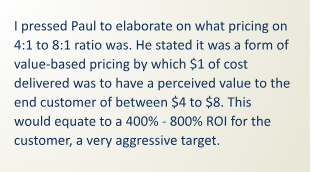 Barnhurst’s response: A company I worked for “believed finance should be involved in pricing [strategy] and that every product should be priced between a 4:1 to 8:1 value for the customer.” Before presentation to the prospect, “the product team had to show a calculation that the value was in this range for all products and customer deals or obtain a justification on why it was not.” He goes on to say, “that experience taught me a lot about value pricing and how to think about it.”
What are the biggest myths or misconceptions businesses have about effective pricing?
Barnhurst’s response: “I think one myth is that customers make the decision on price. It is about so much more than just pricing. Another misconception is that pricing only needs to be reviewed periodically and during times of inflation. A coherent pricing strategy is important for every business.”
That is such a great point. There is a tendency to only update pricing once a year with clients or upon product/contract renewal when the most important factor isn't a set frequency, but staying on top of market trends, competitor actions, and internal costs. Continuously analyzing, adapting, and optimizing a company’s pricing strategy will support maximum profitability, but also ensure that your business is delivering the best value to its customers.
What are the biggest pricing challenges faced by businesses today?
Barnhurst’s response: “I think businesses today are facing pushback from customers especially in the consumer goods range with the high inflation we have experienced the last few years. Customers are being forced to look for cheaper alternatives. Businesses are trying to find the right balance between raising prices and maintaining customers.”
Many markets today continue to be very dynamic, which causes prices to become outdated quickly. Ever since COVID, I have seen many companies struggle to anticipate and react to fluctuations in customer preferences, competitor actions, and economic shifts, leading to missed opportunities or profit erosion. Recently, I have heard a lot more discussion on pricing strategy with business owners asking, should I move to value-based pricing, cost-plus pricing, or competitive pricing? Of course, there is no one good answer, but I do believe consistency matters. Switching pricing strategy often will frequently lead to customer confusion and possible lost revenue.
How can FP&A professionals contribute to developing an effective pricing strategy?
Barnhurst’s response: “FP&A professionals can help in a few ways.
- First, FP&A professionals need to make sure the business has a full understanding of cost so that when something is priced, everyone understands the impacts on the business of the price.
- Play a role in helping educate sales on the margins earned on different products and at different prices and ensure sales plans incorporate not just revenue but also margins to protect the business.
- FP&A should be a member of a pricing committee. Every company should have a pricing committee.”
I completely agree. FP&A has a unique skill set to support leadership when making pricing decisions and can include performing:
- Cost Analysis & Modeling
- Data Analysis and Insights
- Communication and Collaboration
- Negotiation support
- Promotion and discount effectiveness evaluation
- New product pricing
What are some key metrics FP&A should track to monitor the effectiveness of pricing strategies?
Barnhurst’s response: “FP&A must first understand margins. I worked for a company that we could not even tell you the margins we were earning on our different products, and it took months to figure it out. It starts with understanding the product and in many instances customer pricing. From there it is important to monitor the sales team’s average contract and product value, how much are they discounting and why? If we have a discounting problem the company needs to be aware of this.”
Understanding gross profit margins and keeping a pulse on the sales team and any discounting is a smart move for any business leader. Outside of pure internal financial metrics, I have also seen how changes in pricing affect Customer Acquisition Cost (CAC), Customer Lifetime Value (CLTV), and price elasticity. In addition, there are potential downstream effects such as order size and inventory turn. If the goal is to grow a business to sell, then an external look at industry benchmarks and competitor pricing will better inform you as to your business’s place in the market and what may need to be improved before a sale.
How can FP&A help businesses implement value-based pricing strategies?
Barnhurst’s response: “It starts with having discussions with product and sales to identify what the value is for the different products. This is often easier said than done, but with a culture that focuses on value-based pricing it becomes much easier to implement these strategies.”
Implementing value-based pricing effectively requires strong collaboration between various departments, and FP&A plays a crucial role due to their expertise in analysis, data interpretation, and financial modeling.
How can companies use price segmentation and differential pricing to maximize revenues?
Barnhurst’s response: “Price segmentation starts with being able to segment your customers. An industry that is really good at this is the airline industry. When someone buys a plane ticket, they are all fundamentally buying the same product which is getting from point A to point B but the price paid varies widely depending on the class, the seat you want, the amenities, etc. Walking through all the value points of your product and asking how it is different for each customer will help with this.”
I love the airline example. You are taking a fundamentally identical service (safe transport from place A to place B) and segmenting by “how” you want to get there. The key points in this type of analysis typically come down to the identification of either:
- Distinct groups: segmenting customers based on demographics, purchase behavior, value perceptions, or any relevant criteria.
- Unique needs: segmenting customers on the value drivers and pain points for each segment. What features do they prioritize? What are their budget constraints?
What are some common pricing mistakes businesses make, and how can FP&A help avoid them?
Barnhurst’s response: “The biggest mistake is not to view pricing as strategic, just set it like the competition and focus on all the other aspects of the business. The second is not having a pricing committee and a process to ensure all products are capturing the appropriate costs when being priced. Nobody wants to price a product only to find out later you are losing money.”
Those are good points; I would add the following as well:
- Using cost-plus pricing without value consideration
- Ignoring competitor pricing analysis
- Underestimating or overestimating price elasticity
- Inconsistent pricing across channels or segments
- Relying on intuition or guesswork instead of data analysis
- Ineffective communication and collaboration among finance, sales, product, and other stakeholders within the company
- Failing to adapt to changing market conditions
What are some creative pricing models besides fixed pricing that companies should consider (e.g., dynamic pricing, tiered pricing, packaging)?
Barnhurst’s response: “I am a big fan of usage-based models. Sometimes the challenge is figuring out what is the right measure of usage, but this gives more control to the customer and typically results in more revenue for the business. “
I have heard usage-based pricing models referred to as pay-as-you-go as well. Although many pricing strategies have become mainstream in at least one or more industries in which they make sense, some other less traditional pricing strategies include:
- Outcome-based pricing: Charge based on achieved results, aligning incentives with customer success. Example: Software companies charging per active user or completed transaction.
- Freemium model: Offer a basic version for free, attracting a large user base and converting some to paid premium features.
- Real-time pricing: Adjust prices based on demand, competition, and other factors (e.g., airline tickets, hotels).
- Time-based pricing: Offer peak and off-peak pricing to manage demand and optimize resource allocation.
- Surge pricing: Increase prices during periods of high demand to capture maximum value (e.g., Uber during rush hour).
- Product/service bundling: Combine complementary products or services at a discounted price, increasing perceived value and encouraging larger purchases. Telecom companies do a lot of this.
How can FP&A help businesses identify and capture hidden value opportunities through pricing?
Barnhurst’s Response: Some of the ways Paul has been able to do that include:
- “By understanding customer profitability so our sales and account teams could have those difficult conversations.
- Review billing and make sure we are billing customers correctly. This is not exactly price-related, but it is a start.
- Ensuring contracts, where it is appropriate, have clauses to increase price annually based on some inflation trigger.
- Making sure that all pass-through costs are passed on to the customer. I have seen where we were not passing these costs onto customers, and this is often a simple way to obtain more margin that customers understand."
It sounds like a lot of value-added work you did in support of company profitability involved getting to know the business and then partnering with the right people to better service the customer base in the way that most made sense to them and for the company.
Conclusion
By now, you've equipped yourself with an arsenal of FP&A best practices, insight and hacks. Remember, pricing isn't a static destination, it's a continuous journey of discovery and adaptation. Here are some parting words to guide you on your path:
- Embrace the data-driven approach: Pricing decisions shouldn't be made in a vacuum. Leverage data to inform your strategies, track progress, and measure success. Remember, data is your friend, not your foe.
- Stay agile and adaptable: The market is constantly evolving, so should your pricing strategies. Be prepared to adjust your pricing based on market trends, competitor moves, and customer feedback.
- Communicate effectively: Pricing decisions impact everyone, from sales and marketing to production and finance. Ensure clear communication and collaboration across all departments to ensure alignment and success.
- Never stop learning: The world of pricing is vast and ever-changing. Stay curious, explore new ideas, and continuously seek out opportunities to improve your skills and knowledge.
By following these principles and leveraging the insights above, you can transform yourself from an FP&A pro into a true pricing mastermind. Remember, pricing isn't just about numbers; it's about creating value for your customers and maximizing profitability for your company. So, go forth, price with confidence, and watch your bottom line flourish.

Ken Fick is a CPA, and MBA with over 25 years of finance experience providing leading-edge solutions designed to improve forecasting, budgeting, planning, and decision-making to companies from $3 million to over $50 billion in revenue. He is a freelance writer that focuses on producing engaging content on all things business, accounting, finance and investment related. You can view a sampling of his published work at FPAexperts.com.