Rethinking Online Visibility in an AI-Driven World
Say Hello to GEO

For years now, SEO (Search Engine Optimization) has been considered the bedrock of online visibility. But as large language models (LLMs) like ChatGPT, Gemini, and others increasingly power how people search, the rules of the game are shifting. Traditional SEO is no longer enough to help a brand stay relevant. Instead, brands must add new layers that include GEO (Generative Engine Optimization), digital public relations (PR), and LLM-optimized content.
In this article, we’ll explore how search is evolving, why focusing solely on classic SEO is risky, and how to build a future-proof strategy that combines technical foundations with artificial intelligence (AI) visibility.
Why Isn’t SEO Enough Anymore?
1. Zero-click and AI summaries are multiplying
Search is becoming more conversational and answer-driven. Instead of clicking through multiple pages, users increasingly receive direct answers from AI systems or see “AI overviews” positioned above traditional results. This reduces click-through traffic and changes how visibility is won.
2. LLMs synthesize; they don’t rank
Unlike search engines that index individual pages and rank them, LLMs gather information from many sources and generate synthesized responses. That means a brand’s content may be cited or summarized without ever ranking in the top 10 search results. In fact, some data suggests only a small fraction of URLs cited in LLM responses even appear in top search result positions.
3. Authority comes from “being quoteable” rather than backlinks
Backlinks and domain authority still matter, but AI models value clarity, authority, and trust signals — particularly when content is well structured, evidence-backed, and easily extractable. In many cases, earned media and third-party recognition (think customer reviews and influencer attention) have more influence in AI search than traditional on-site SEO factors. This is why understanding digital PR is important.
What Is GEO — And Why Does It Matter?
GEO was introduced by researchers in 2023 as part of a study on the future of online content. Put simply, GEO is the creation and improvement of content so that it’s more likely to be used, cited, or referenced by AI-powered systems answering user queries.
Where traditional SEO emphasizes rankings and click-throughs, GEO emphasizes inclusion in AI-driven answers. Certain optimization practices were shown to consistently increase the likelihood of content being included or cited in generative answers.
GEO isn’t a replacement for SEO; rather, it complements existing SEO practices by adding the goal of building visibility both in search results and within the AI responses that many users now see first. Businesses and marketing teams looking to remain visible have no choice but to adjust to this shift. A 2025 Bain & Company study concluded that 80% of consumers now rely on AI-written results for at least 40% of their searches and that organic web traffic has reduced by 15%-25%.
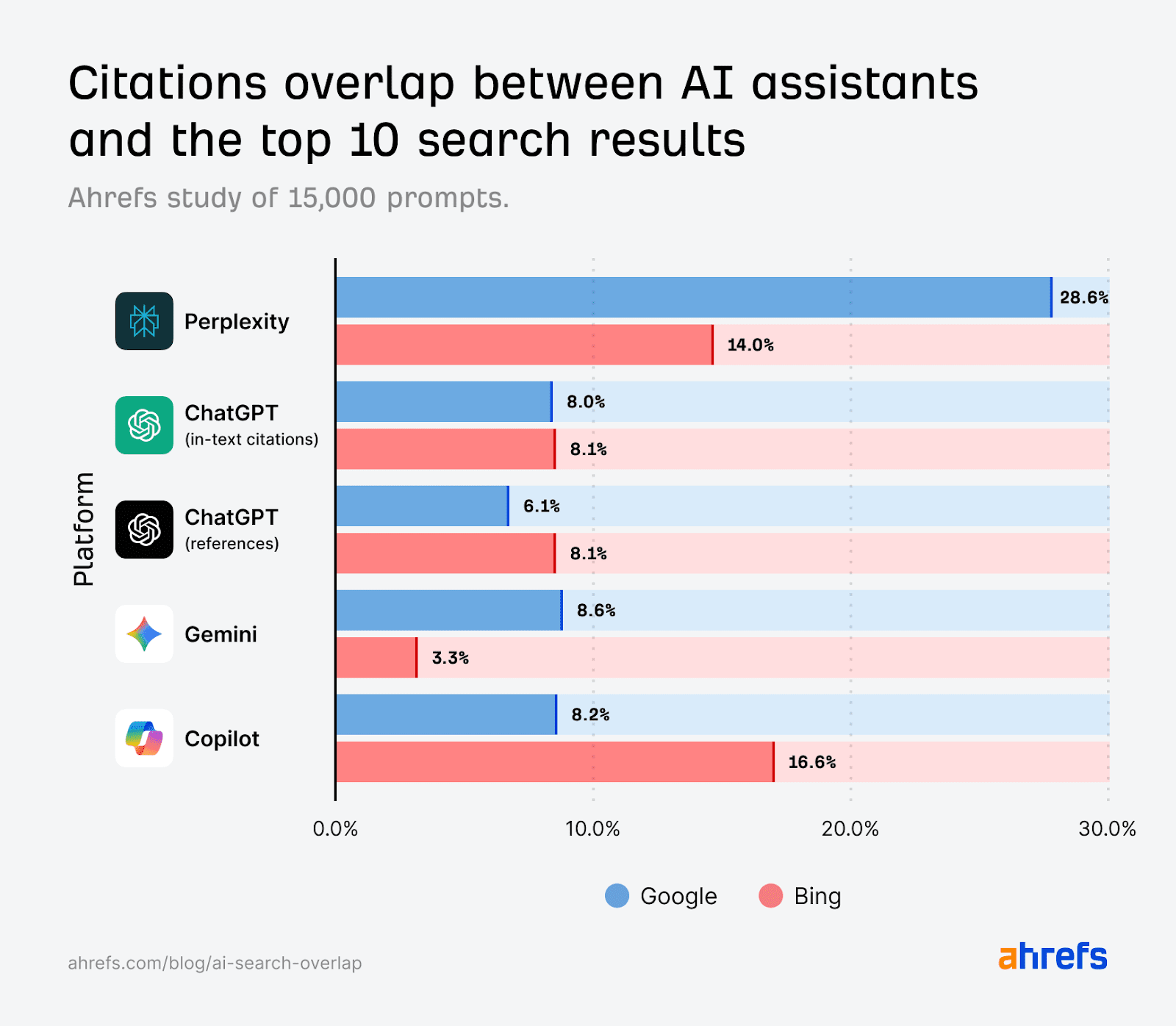
This means that, even if you have the best product, service, or content, if you are not focusing on GEO, you’re likely missing a significant number of potential customers who will simply never discover you. In fact, another study, conducted for Ahrefs by data scientist Xibeijia Guan, indicated that in a dataset of 15,000 prompts, an average of only 12% of links cited by ChatGPT, Gemini, and Copilot appear in Google’s top 10 results for the same prompt. You can see a more detailed breakdown in Ahref’s chart, below:
What Is Digital PR?
Digital PR is the practice of earning authoritative online mentions and coverage to build credibility, brand visibility, and backlinks. Unlike traditional PR, digital PR doesn’t rely on official press releases for information but leverages the numerous online platforms — such as e-books, blogs, podcasts, social media, and industry sites — to highlight a brand’s expertise or news.
In the past, PR was a way to manage reputations and make big public announcements. In the AI-driven search era, digital PR is a way to earn citations that generative engines trust. When your brand is quoted in a respected industry publication, featured in a podcast transcript, or mentioned in a data roundup, it creates digital footprints that large language models are likely to recognize and use.
Three Main Components of a New Visibility Strategy
To thrive in this new era, brands should lean into three strategic pillars:
1. GEO/LLM-First Content
- Write content that’s easy for an AI to parse and cite: concise definitions, clear statistics, bulleted lists, Q&A sections, and evidence tables.
- Use clear, consistent terminology (entities) so models reliably connect your content with the correct concepts.
- Lead with direct answers (40–60 words), then expand, helping the AI extract a snippet if needed.
- Maintain strong internal linking and topical clusters, signaling depth of coverage.
2. Digital PR & Earned Media
- In the AI era, citation counts matter. Landing mentions, quotes, and featured pieces on high-authority sites improves your chance of being seen and trusted by LLMs.
- Use PR to build authoritative mentions in industry publications, research reports, podcasts, and guest contributions.
- Create shareable data, surveys, and proprietary research that others reference — those linkbacks and mentions double as AI signals.
3. Strong SEO Foundations (Still Essential)
- Ensure site speed, crawlability, and clean technical architecture — AI bots still rely on clean signals.
- Use structured data (FAQs, How-Tos, schema markup) to help generative systems understand page structure.
- Optimize meta titles/descriptions, headings, and on-page content for both humans and machines.
- Continue building relevant backlinks — these support your authority in both search and AI contexts.
Putting It All Together: A GEO-Enabled Workflow
Here’s a step-by-step approach to pivoting from pure SEO to a hybrid model that includes GEO:
1. Audit your current visibility
- Identify pages that drive traffic and those that perform poorly.
- Map out important queries in your domain and check whether your content is referenced in AI summaries or search overviews.
2. Refresh existing content
- Add snippet-compatible answers, update facts, insert evidence tables, and clarify language.
- Introduce schema markup and improve internal linking.
3. Build new GEO-ready content
- Focus on high-value topics, niche questions, and FAQ clusters.
- Make content concise, fact-rich, and easily skimmable.
- Embed original data, quotes, or insights that help it stand out.
4. Leverage digital PR
- Pitch guest posts to industry sites.
- Distribute your data, insights, or studies widely to be referenced and cited.
- Engage on platforms that influence AI models (LinkedIn, industry forums, expert roundups).
5. Track AI performance metrics
- AI citation rate: How often your content is cited by LLMs.
- Generative inclusion share: Percent of target queries where your content appears in AI answers.
- Snippet win rate: How often your “answer-first” lines become the portion AI uses.
- Continue to monitor traditional SEO metrics (rankings, organic traffic) to ensure the foundation stays strong.
6. Iterate & refine
- Continuously test which content types and formats get picked up by AI.
- Use feedback loops (which snippets are used, which aren’t) to adjust content structure.
Challenges & Considerations
- Opacity of AI models: LLMs are black boxes. You won’t always know exactly how it chooses sources.
- Competing for attention: Large or established sites may dominate citations — smaller brands may need to find narrower niches.
- Maintain brand voice: Even while optimizing for machines, stay true to your brand’s tone and readability.
- Balancing breadth and depth: Go too shallow, and AI won’t use you; too specific, and you may limit reach.
The Future of Visibility
For now, AI assistants and search engines co-exist; some users will still click links, but many will settle for direct answers. To win, your content must serve both flows. SEO remains important, but it’s no longer sufficient on its own.
The brands that succeed will be those that preserve strong technical and UX foundations, and master answer-first content that’s easy for AI to extract. They will also build visibility through earned, third-party signals, and adopt workflows (prompting, quality assurance, measurement) optimized for AI discovery.
For business buyers and sellers, understanding GEO is a factor in long-term value. Companies with strong generative visibility, credible digital PR, and AI-ready content are better positioned to attract customers and command attention from investors. And buyers who have acquired an already stable business, can ramp up visibility (and hopefully profit) by employing strong GEO techniques. Whether you’re preparing to sell or evaluating your next acquisition, consider how a company shows up in this new digital search era as you explore opportunities on DealStream.

Nichole Brazelton has her MA in Communication from Duquesne University and her MFA from New England College. She is an adjunct professor and freelance writer. Her academic, business, and creative writings have appeared in national and international publications.