Bedridden to Businessman: Raising $800k from Individual Investors to Buy an $8 Million Biz
A very serious health scare leads this musician to entrepreneurship.

Everybody knows what to do when life gives you lemons.
But what life dishes out isn’t always sweet.
It certainly wasn’t for Kevin Bibelhausen in 2021, when he was afflicted with a Covid-related health issue that he wasn’t entirely certain he would recover from.
Happily, Kevin did recover.
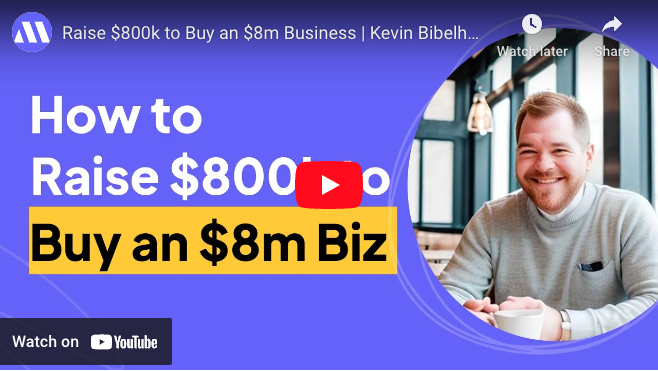
What’s more, he re-evaluated his life and made big, bold changes.
Today Kevin is the owner and president of Heritage Fabrics, a 20-year-old wholesale fabrics business doing nearly $10 million a year in sales. He’s also a general partner in a fund to invest in other searcher deals.
To pull it all off, he scraped together $800k from small investors that he didn’t already know.
Kevin’s story is a testament to the fact that while sometimes life may give lemons, other times one has to go tree to tree, shaking every bough, in order to make lemonade.
Kevin Goes from Opera Singer to Corporate to Fledgling Entrepreneur and Back to Corporate Again
Kevin graduated college with a music degree.
He followed it up with a master’s degree in music before working for a while as a professional opera singer. Kevin was mulling over continuing his music education even further and pursuing a doctorate but decided to turn away from professional music.
“It’s hard to make a living doing that.”
He spent the next decade in corporate across a variety of roles in sales, project management, and software before settling into leadership for technology and strategy ops in a healthcare business.
Kevin enjoyed the business, and his father had been in healthcare, but he felt something was missing.
He knew he had an entrepreneurial streak.
Kevin picked up a copy of the Harvard Business Review guide (which had only just been published), acted on his instinct, and tried to buy a business.
Unfortunately, this first foray didn’t pan out. The deal fell apart in financing when it became apparent the deal would require more money than the parties had initially envisioned and more than Kevin had at his disposal.
“I didn’t know you could raise capital back then. I kind of licked my wounds and went back to my corporate job.”
Kevin Suffers a Health Scare That Changes Everything
In 2021 while working in healthcare during the height of the pandemic, Kevin contracted Covid and developed the serious complication myocarditis.
At only 30 years old, he was told he would need a heart transplant.
Kevin spent most of that year in the hospital hooked up to what his doctors affectionately termed “rocket fuel” to keep his heart ticking.
Ultimately Kevin did not need a heart transplant, a very fortunate outcome he chalks up to his relative youth and a positive response to his medications.
Still, the experience had been an extraordinarily powerful one. Kevin had spent time in palliative care, having serious end-of-life discussions.
“It was one of those sobering, clarifying experiences. What do I want to do when all of this is over? Am I happy doing what I’m doing? Is this the life I want to be leading? The answer I kept coming to was, No.
Kevin still wanted to be a small business owner. He wanted to create value for himself and his family.
Kevin, Back in the Saddle, Launches His Second Search
In 2022 Kevin started looking for another business to buy.
Right away, he was struck by how far the world of small business acquisition had come in just a handful of years. A fully-fledged online community had sprung up around the topic during the intervening years.
This was welcome news to Kevin.
“I needed the support and the help and the network to be able to do what I wanted to do.”
He left his corporate job, took on some consulting gigs to pay the bills, and set for himself a deadline of one year to buy a business.
Kevin stuck to a brokered search and got the ball rolling, getting on broker lists and setting up calls.
All the while, he was diving into the burgeoning SMB community. He attended a meetup in Dallas and then a boot camp in Tampa, where he made valuable connections.
Though he would have preferred to remain in Texas at the time, he was open to any geography.
“I would have moved anywhere for the right business.”
Initially, Kevin looked for what he knew, healthcare companies and IT services.
These companies, however, were listed with multiples based on their unsustainable banner years during Covid and were dramatically overvalued.
Soon enough, he came upon Heritage Fabrics. The multiple was reasonable, and the owner audited financials every year.
“I knew what I was buying, and for my first acquisition that was really important.”
Kevin decided to go for it and began working with a capital provider to secure the necessary funding.
“I was scared to raise capital because I didn’t know what I was doing. I don’t have a network of high-net-worth individuals in my rolodex.”
Three days before signing, the capital provider backed out, leaving Kevin high and dry.
He reached out to contacts he’d met in Dallas and Tampa and was told, based on the work he had put in and the strength of the deal, “You can do this!”
They passed along a public-domain list of investors, and Kevin got to work reaching out to each and every one.
He went down the list calling and sending out an automated teaser that linked to an NDA. Once signed, the prospective investor would receive a link to Kevin’s batch of materials. A few days later, he would follow up.
All told it took Kevin five weeks to raise $800k from dozens of investors using this method.
“It’s a wild process and it’s incredibly stressful.”
Despite the difficulty, Kevin is glad he raised the funds this way.
“I kind of love the fact that my entire cap table is filled out with these small investors. I want to be able to reward them with, ‘hey, thanks for trusting me.’”
(For more on raising money from investors to buy a small business, see How to Raise Money from Investors to Buy a Business.)
Kevin Buys Heritage Fabrics and Learns the Ropes (or Threads)
Funding secured, Kevin bought Heritage Fabrics in North Carolina for between $7m and $8m.
He had no experience with textiles.
The business itself is one of the country’s biggest suppliers to interior design companies, mostly known for sheers and drapery. They work with mills to collaborate on design, color, and construction before having the weaving done overseas and importing the fabrics back to sell to companies who work with interior designers, who in turn do business with hotels, etc.
To advertise, Kevin and Heritage Fabrics attend trade shows, with the most recent in High Point, NC, generating an excellent response.
Heritage Fabrics’ customers then take those designs that they’re interested in from the show and put together books of fabrics to offer their own customers.
“I think of us as more of a design house.”
The business brings in about $10 million in revenue with an SDE of $1.7 million and an average gross margin of 50%.
Kevin was very fortunate to be able to buy such a high-earning business when he could easily have been muscled aside by a big private equity firm. This was thanks to the old owner, who was adamant about taking care of his staff.
“He desperately wanted the business to stay independent. And as I go around and travel and talk to customers, I realized how big of a deal that was and how well he set me up that way. As suppliers go in and out of business, the ones that, like us, have been consistent, maintained stock, we don’t play games with keeping low shelf quantities. Our business is inventory.”
It was this strong reputation and trust in the old owner himself that had facilitated Kevin’s deal and put him in such a strong position looking forward.
No transition is without its challenges though, and Kevin’s was no different.
After taking over the business in earnest, he found himself undercapitalized as a result of not fully appreciating the business’ long sales cycle. He had to order material in January 2023 for $300k that he didn’t have for product that might not be sold until 2024.
Fortunately, Heritage Fabrics already had a large and valuable inventory against which Kevin could borrow to float expenses such as these and fuel further growth.
Kevin sees the long bets involved in the business’ cash management strategy as a recurring challenge but a fun one that he’s excited to continue to meet.
What’s Next for Kevin and the People of Heritage Fabrics
Kevin is keenly aware of what’s driving the success of his new business.
“Without people you don’t have a business.”
For Kevin, investing in his people is the most important step to take going forward.
“I want to do everything I can to support them and help them flourish, professionally and economically. And doing so is a privilege. It’s a differentiator we have in small business vs corporates. I don’t have to go and ask permission from my boss’ boss to give somebody a raise.”
Kevin’s next step for Heritage Fabrics is to leverage this nimbleness to bring in improvements and new technology to reduce remedial tasks and allow his team to better focus and develop their talents.
“I think if you’re not providing those growth opportunities and you’re not providing the flexibility that you can offer as a small business owner, I think you’re missing the boat.”
The people at Heritage Fabrics aren’t the only ones Kevin is now looking to invest in.
After struggling twice, and failing once, to raise funding during his searches, Kevin is now part of a new group of investors, Fruition Capital, who aim to help searchers like himself reduce stress during the fundraising process.
Kevin relied on connections he made in the community to finalize his own deal, and as part of Fruition Capital, he’ll have a chance to pay it forward. They are currently raising their inaugural $5 million fund.
How does Kevin feel about the future of both Heritage Fabrics and the broader small business acquisition community?
“I can’t imagine doing anything else. Everybody wants everyone else to succeed because there’s plenty of room for everybody.”

Will Smith hosts the podcast Acquiring Minds, interviewing entrepreneurs who buy businesses.