Inside the World of Business Brokerage
Business Broker? What’s That?

I have been a business broker for 11 years now, and neither my wife and kids, nor my parents and siblings, nor my in-laws really know what the heck I do. God bless my dad because he is really the only one that asks questions and tries to understand. He knows what a closing means!
Generally, I am the only business broker people know. And they don’t really know what I do. So, it’s certainly not unusual if you do not know a business broker, or even really know what one does. We are a riddle wrapped in a mystery inside an enigma.
A Jack of All Trades…and Master of None
My clients will hear two things from me consistently over the course of our listing engagement:
- I am not a lawyer.
- I am not an accountant.
I am sure there are business brokers who are both of those things as well. But what I mean is that a business broker acting in their broker capacity is not a lawyer, nor are they an accountant. This is important to keep in mind because a business broker treads in both of those worlds on a consistent basis.
Business brokers should not, and by law cannot, give legal and/or accounting or tax advice without those certifications and licenses. Yet we deal with those topics on a regular basis. The very nature of selling businesses involves a web of legal and tax ramifications. The business broker floats in between these worlds.
But a good business broker will stay in their lane. And our lane is wide. Over the course of a listing, business brokers will do the following — and more — as they represent a business:
- Be a fiduciary. The business broker represents one of the parties. There is no dual agency.
- Be a marketer. Email marketer and telemarketer.
- Be a salesman.
- Be a negotiator.
- Be a dealmaker.
- Be a teacher.
- Be a coach.
- Be an orator — you must represent the business to buyers verbally as well.
- Conduct high-level financial analysis.
- Interact with legal and tax professionals.
- Think like a lender.
- Think like a buyer.
- Be a solution provider.
The Process
If you are a football fan, then you have likely heard the name Nick Saban. He recently retired from the University of Alabama as arguably the most successful college football coach of all time. Saban did not preach winning, per se. Saban preached following the process.
This is very much applicable to selling a business. Selling a business is a process. From the outset, a good business broker follows a process to learn about the business.
All too often, business brokers show up at the first meeting with a listing agreement in hand. “Rush to list” is the philosophy, and they’ll say nearly anything to get it done. Let me give you a piece of advice: Every business broker in America, and probably in the world, has a buyer at this exact moment in time ready to buy your business right now — at full price and in cash.
You will find this to be true, until you list your business with said broker and the buyer mysteriously disappears. Take everything with a grain of salt — including this article.
Rather than rush to list, a good business broker will take time to listen and learn. Here is an example of a sound process:
- Initialize contact of a potential seller prospect. Set up a face-to-face meeting. If you’re long-distance, it must be a Zoom meeting. During this meeting, get to know the seller and their business and introduce the broker (yourself), the firm and the process.
- Immediately send the seller a checklist and begin gathering information.
This is our process upon first contact. Below is a partial snapshot of our checklist:
Before we ever discuss listing the business, we qualify the listing with an in-depth financial analysis. We want to see documented financials, revenues, and cash flow. This includes conducting a financial recast.

Within the financial recast is a range of values based on our research into industry norms, rules of thumb, cash flow analysis, and more. This is done to determine the most reasonable selling price of the business.
The seller may not agree with the conclusion, but at least gets a very detailed accounting of their business. We do this free of charge. Why? We want to know if this is a business we want to work with.
If we think we have a 70% chance or better of selling the business, then we move to the next step in our process: Take the listing.
To Fee, or Not to Fee?
Most business brokerages operate on a “Sole & Exclusive Right-to-Sell Agreement.” This means there is no dual agency. The broker and the firm represent the seller. Likewise, the seller is agreeing to the firm’s process of selling the business. All buyers are directed through the firm.
The practice of charging upfront fees is not standardized in business brokerage. The “middle market” merger and acquisition (M&A) firms may charge upwards of $15,000 or more for a retainer of services. That’s not unusual in eight-figure deals or higher. Main Street firms, those deals at $5M or less, may or may not charge upfront fees. If so, they should be far less than $15,000.
My firm charges a “marketing fee” of $3,000. Why do we charge this? Two reasons, primarily.
One, confidential marketing. Business brokers know how to do this. We specialize in marketing businesses for sale confidentially. No business name, no owner name, no business location. No sign in the yard. No sign in the window. Nobody knows. Our fee is designed to help offset company expenses because we market very aggressively.
Two, skin-in-the-game. If you take nothing else from this article, take the following. There is one primary ingredient that must be present in every deal to get the deal closed. That ingredient is motivation. A motivated buyer and a motivated seller overcome obstacles and get deals done. The seller being willing to participate in the process shows motivation.
Maybe we lose a client because of this, but a good brokerage firm is not chasing listings. One thing to keep in mind, too often in life you get what you pay for.
What’s the Commission, Already?
A business broker only gets paid when they close a deal. It is standard to encounter a flat 10% commission fee. This is 10% of the final sales price. Some firms also have a minimum. My firm has a minimum commission of $25,000.
I have heard of firms that charge 8% commission. I remember attending an International Business Brokers Association (IBBA) conference in the past and a broker from Canada said they were charging 12%. A broker in Houston said they were charging 12%. But most business brokerage firms charge a 10% commission rate.
We often take listings with the business and real estate at 10% for the entire package. This is common practice, too. We will negotiate our rate on the real estate at times, but in most cases our clients are more than agreeable to our commission.
The value of the business we determine on the front end is determined independently of the commission. While maximizing value is important, ensuring a reasonable value considers cash flow and debt service over commission amount. Personally speaking, I will consider the seller’s needs and work to fulfill those needs — but if those needs are outside of reasonable expectations, a good broker points that out.
There are exceptions to the 10% rule of thumb. One is when the seller has a pre-identified buyer in place. We will run the process at 8%. If that buyer does not work out, we roll the listing out to the public at our standard 10% rate.
There are other methods to figure commissions. Perhaps you have heard of the Lehman Scale, or the Double (or Modern) Lehman Scale. These are popular in middle market M&A deals because the commission tiers from a higher percentage to a lower percentage. A structure of this nature makes sense when deals begin to reach the high seven- and eight-figure range. We do not consider these commission scales until deals reach, at a minimum, over $5M.
DealStream’s article linked to above gives a very detailed account of the Lehman and Double Lehman Scales.
Run the Play
If the seller is agreeable on price and terms, and the broker feels good about the listing, then the listing agreement is signed. Now the broker wears another hat.
The broker becomes marketer. The process of finding a buyer begins. (See the marketing plan example, below.) Brokers become content creators and marketers. Brokers, or the brokerage firm, are also responsible for creating the marketing material used in confidentially marketing the business and in disclosing the business to qualified buyers.
We use two documents to primarily represent businesses:
- A blind profile. This is bait used on various business-for-sale websites, in emailing and direct mailing campaigns, and more. There is no name of the business, business owner or location. Only the firm’s name and vague details are given.
- A Confidential Business Review (Offering Memorandum). This document discloses full details of the business. We create a 15-20 page PDF document with maps, inventory lists, equipment lists, and other pertinent details only disclosed to qualified and vetted buyers under a non-disclosure agreement (NDA).
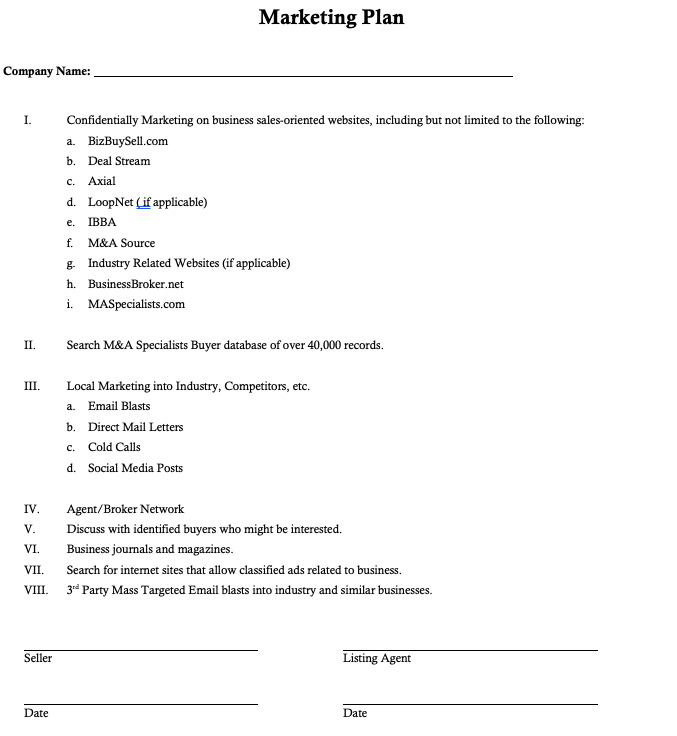
We push out the blind profile and begin screening and qualifying buyers. This involves financial qualification and the buyer signing an NDA. If the process moves forward, then the broker negotiates on behalf of the seller, sets meetings, sets up conference calls, answers questions, and ultimately works the deal through due diligence.
Close the Deal
Depending on the closing process utilized, a broker may or may not be very involved. If a closing attorney is used to draft the initial closing documents, the broker becomes the deal’s secretary at this point. Primary duties include keeping track of scheduled meetings, deadlines, needs, and more. Excellent organization and documentation are critical.
An effective firm has processes in place to keep the deal moving forward. Various parties must be coordinated, so the broker must maintain an eagle’s eye on the deal to do so. The seller must continue to run the business, and it is up to the broker to keep them informed.
In short, the services of a business broker can be varied. Anything related to confidentially selling a business is a part of the job. And every broker worth their salt can quote, on the spot, the iconic line from the 1992 hit movie “Glengarry Glen Ross”: Always Be Closing.

Shep Campbell works for M&A Specialists out of Little Rock, AR. Campbell has been helping people sell, buy, merge & acquire businesses for ten years. When not in the office, Campbell can be found either on the river, at a horse show, or watching a ball game involving his two kids.